Managing Tailors and Boutique Staff
How to hire, pay, assign work to and keep good tailors — piece rate versus salary, handling quality problems, and why most boutiques lose staff for avoidable reasons.
A boutique's ceiling is set by its tailors. You can improve pricing, marketing and systems, but output depends on a small number of skilled people who are difficult to find and easy to lose.
Most owners learn staff management by making expensive mistakes. This covers the ones worth avoiding.
Piece rate or salary?
The most consequential decision, and both answers are defensible.
Piece rate — paid per garment. Costs scale with work, so a quiet month does not hurt. It rewards speed, which means it can quietly reward rushing. Income is unpredictable for the tailor, which makes good people more willing to leave for stability.
Salary — fixed monthly. Predictable for both sides, easier to retain people, and you can ask someone to spend an hour helping a colleague without an argument about payment. But you carry the cost through slow periods.
Many established boutiques land on a hybrid: a base salary covering living costs plus a per-piece incentive above an agreed output. It stabilises income while keeping some link to productivity.
Whichever you choose, write it down — rate per garment type, when payment happens, what counts as a completed piece. Most pay disputes are definitional, not dishonest.
Hiring: test, do not interview
Interviews tell you very little about stitching. A trial does.
Give a paid trial on real work — a straightforward blouse, with measurements, and let them work as they normally would. Watch for four things:
- Finishing quality, especially the inside. Insides reveal habits that outsides hide.
- Did they follow the measurements, or substitute their own judgement without asking?
- Did they ask when unsure? A tailor who guesses is more expensive than one who interrupts.
- How long it actually took compared with what they said.
Pay for the trial regardless of outcome. Asking skilled people to work free is how you lose the good ones before you start.
Assigning work so nobody waits
The common failure is invisible: a tailor finishes, nobody notices, and they wait twenty minutes for the next job. Three of those a day across three people is more than an hour of paid idle time.
Make the queue visible instead of verbal. Each tailor should be able to see what is assigned to them and what is next, without asking. That removes both the idle time and the constant interruption of the owner.
Match work to strength. One person is better at aari, another faster at plain stitching. Assigning by who is free rather than who is suited is a reliable way to generate alterations.
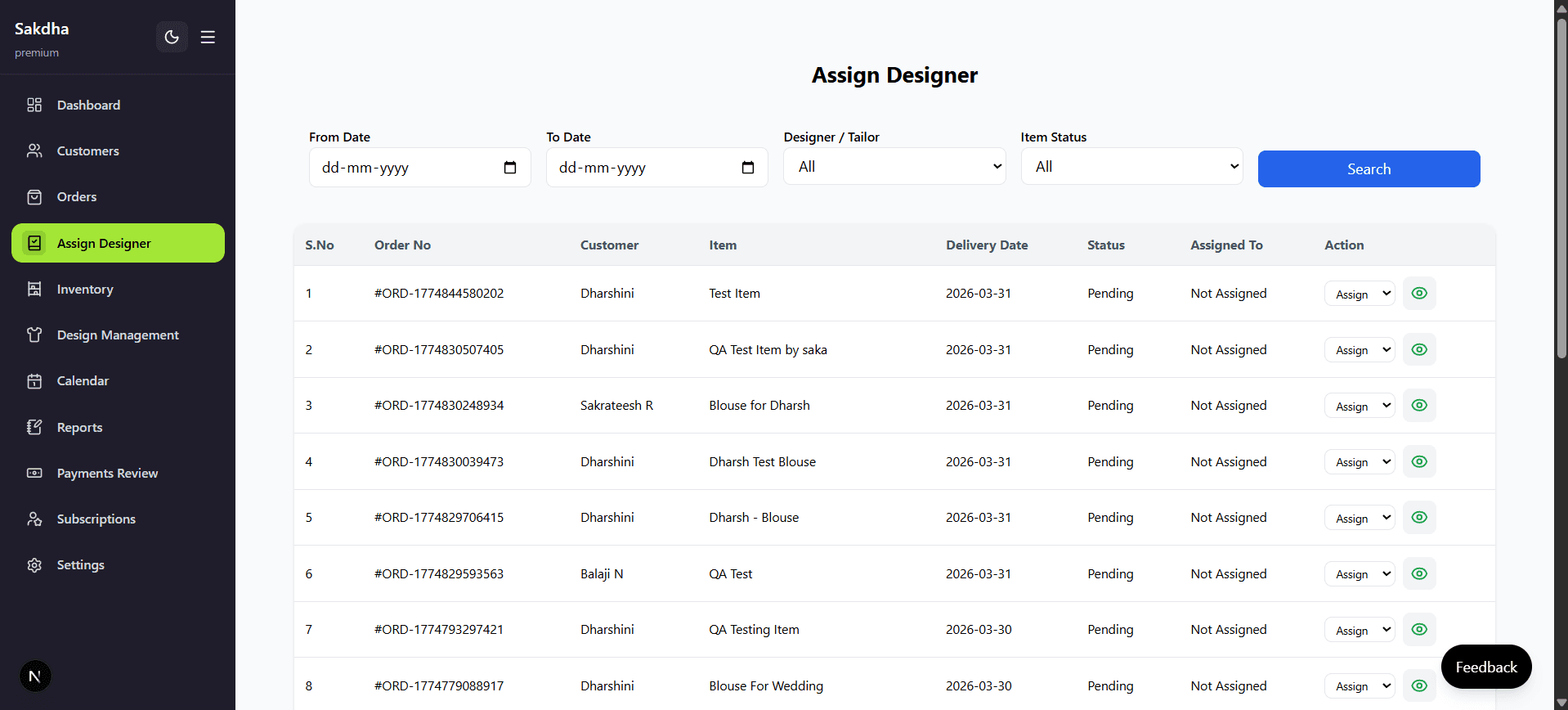
A per-person work queue is the practical form of this — the tailor sees their own list, and you see who is loaded.
When quality slips
Work badly stitched comes back, and the cost lands twice — the rework and the customer's patience. How it is handled determines whether it recurs.
Address it the same day, privately, with the garment in hand. Specific and immediate works; general and delayed does not. "This seam is uneven here" is actionable. "Your quality has dropped lately" starts an argument.
Ask before concluding. Rushed because of an unreasonable deadline you set? Unclear measurements? Difficult fabric? Often the cause is upstream of the tailor.
If a pattern persists after a specific conversation, it is a training issue or a fit issue, and both need deciding rather than tolerating.
Why good tailors leave
Rarely a sudden decision. Usually one of these, accumulated:
- Unpredictable pay. The single biggest driver, especially on piece rate.
- Blame for problems they did not cause. Impossible deadlines, then criticism for the result.
- No respect for their skill. Being overruled on things they know better.
- Poor conditions. Bad lighting and bad chairs cause real physical strain.
- No progression. Doing the same work at the same rate for three years.
Replacing an experienced tailor costs weeks of lower output and a period of quality problems. Almost any retention effort is cheaper.
What to share and what not to
Staff work better knowing what is due this week and where the pressure is. They do not need revenue figures, margins, or what each customer owes.
This is the practical case for role-based access in whatever system you use: a login that shows garments, measurements and deadlines, but not money. Without that separation you are choosing between staff who cannot see enough to be useful and staff who can see everything.
Training someone newer
The cheapest way to raise capacity is to improve someone already with you. It needs protected time — an hour on a slow afternoon, not "watch while I work".
Sequence matters: finishing first, then simple garments start to finish, then cutting. Cutting last, because mistakes there waste fabric rather than time.
Expect the trainee to be slower for a month and plan for it. Boutiques that train during peak season get neither training nor output.
Frequently asked questions
How many tailors do I need?
Work from output, not instinct. If a tailor completes five pieces a week and you average twenty orders, you need four — plus slack for alterations and absence.
Should I hire family?
It works when roles and pay are defined exactly as they would be for anyone else. It fails when "we will sort it out" substitutes for an agreement.
How do I handle someone who is fast but careless?
Make the rework visible. Many piece-rate tailors genuinely do not realise how much of their output returns, because they never see the total.
What about during slow months?
Use them for training, sample pieces for your catalogue, and catching up on alterations. Keeping skilled staff through a slow month is almost always cheaper than rehiring.
The core of it: pay predictably, test before hiring, keep the work queue visible, and address quality the same day with the garment in hand.
🚀 Want to simplify your boutique operations?
Manage orders, measurements, billing, and customers in one place with Boutique Manager.
Start Managing Your
Boutique Like a Pro
Everything you need — orders, customers, measurements, billing — in one powerful platform.