Managing Wedding and Festival Season Orders in a Boutique
How boutiques survive peak season — capacity planning, cut-off dates, deposit policy, managing trials, and the warning signs that you have taken on too much.
Peak season does not arrive gradually. Bookings are ordinary for weeks, then a wedding date is fixed somewhere and suddenly four families want work finished in the same fortnight.
The boutiques that come through it well are not working harder than the ones that struggle. They decided a few things in advance.
Know your real capacity before you need it
You cannot manage a peak you have not measured. Work out, honestly, how many garments your shop completes in a normal week — not the best week you ever had.
Say three tailors each finish five pieces weekly. That is fifteen. Now subtract: alterations on previous work, the trials that pull people off machines, the day someone is ill. A realistic sustainable figure might be twelve.
Twelve is your number. Everything that follows depends on it being honest rather than aspirational.
Set a cut-off date and hold it
For every major date — a wedding, a festival — there is a point after which new orders cannot be completed safely. Work backwards from the event:
- Delivery buffer: 3 days before the event
- Final trial and adjustment: 4 days before delivery
- Stitching: depends on the garment
- Cutting and fabric preparation: 2 days
For a lehenga that might be three weeks. So three weeks before the date, you stop accepting lehengas for it. Not "probably stop" — stop.
The order accepted past the cut-off is the one that ruins the month. It is delivered late or badly, and it damages the reputation that the other eleven orders were building.
Larger deposits during peak
Peak season ties up cash in fabric and overtime before any of it comes back. It is also when cancellations hurt most, because you turned away other work for that slot.
A 50% advance during peak is standard practice and reasonable to state plainly. It funds materials and it filters out the tentative booking that evaporates in week two.
Record every advance against the order the moment it is taken. Peak season is exactly when a verbal "she paid two thousand" gets lost.
Book trials, do not leave them open
"Come anytime for trial" is fine in March. In wedding season it means six people arriving on Saturday afternoon while three tailors stop work to attend to them.
Give a date and a rough time. Cluster them — trials in the morning, uninterrupted stitching in the afternoon. The stitching hours you protect are the reason the work finishes.
Sequence by deadline, not arrival
The natural instinct is to work on whatever came in first. During peak that is wrong. Work on whatever is due first, and within that, on whatever takes longest.
A heavily worked lehenga needed in twelve days must start before a blouse needed in six, because the lehenga cannot be rescued late and the blouse can. Sorting your pending work by delivery date rather than order date is the single highest-value habit in a busy month.
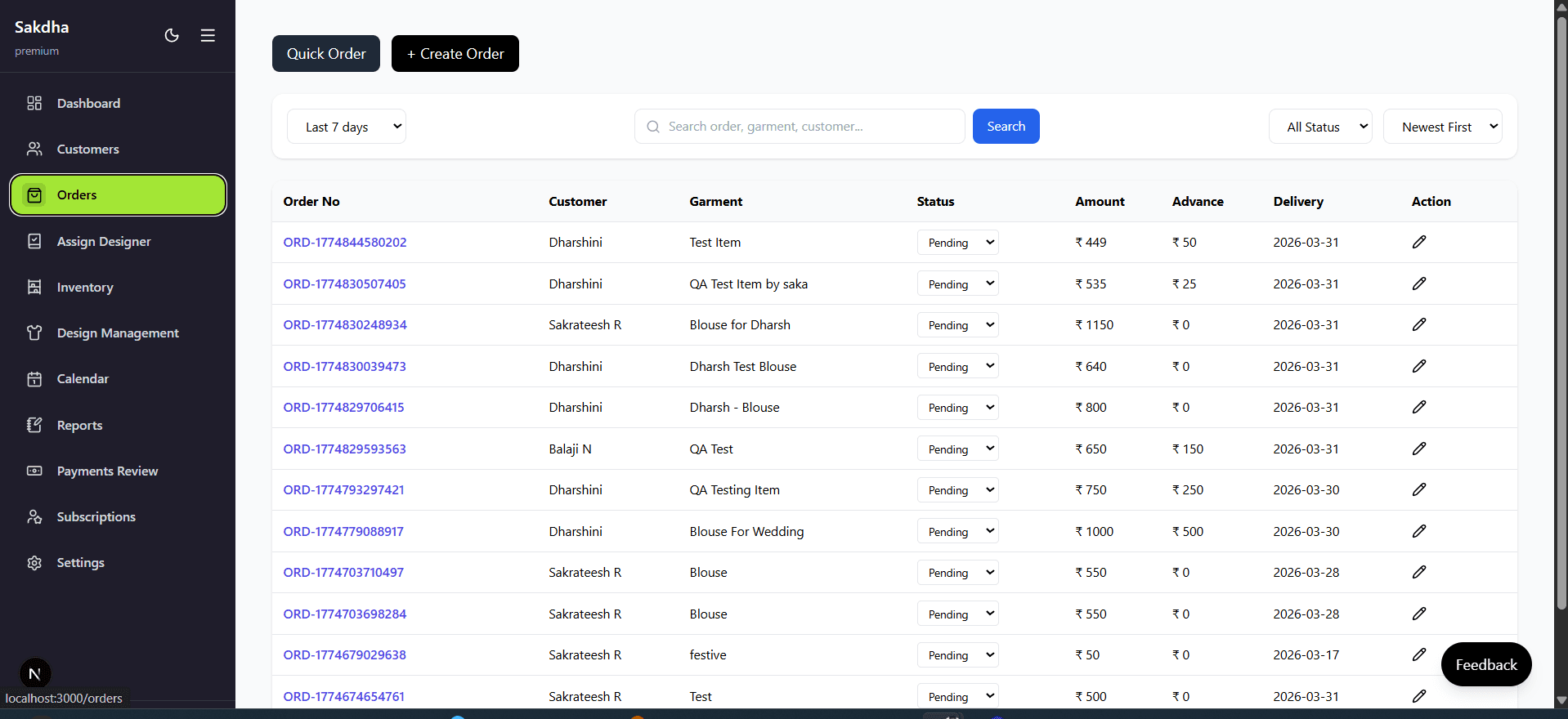
A calendar view of upcoming deliveries makes the pile-up visible weeks ahead, which is the only point at which you can still do something about it.
Watch for the bottleneck
Work does not slow down evenly. It jams at one stage — usually aari work or finishing — while everything upstream keeps feeding it.
If you track production stages you will see it as a growing count at one step. The responses are limited and all need deciding early: move someone onto that stage, outsource it, or stop accepting work that requires it.
Noticing a bottleneck in week one is a scheduling decision. Noticing it in week three is an apology.
Decide in advance what you will say no to
Saying no in the moment, to a customer standing in front of you, is hard. Deciding the rule beforehand makes it easy:
- No new bridal work within three weeks of the date
- No design changes after cutting
- Rush orders only at the rush rate, only if a slot genuinely exists
- No more than two bridal sets in any one week
Write them down before the season. In the moment you are not refusing the customer, you are relaying a policy — which is far easier to say and far easier to hear.
Keep customers informed before they ask
Most peak-season complaints are not about lateness. They are about silence. A customer who is told on Tuesday that her blouse is at finishing and will be ready Friday does not call on Wednesday.
A quick message at two or three points — work started, ready for trial, ready for collection — removes most of the phone calls that would otherwise interrupt the work.
Warning signs you have overcommitted
- You cannot say what is due next week without checking
- Tailors are asking what to work on, repeatedly
- Trials are being pushed back more than once
- You are starting new work before finishing the previous stage
- Alterations are queueing behind new orders
The last one is the clearest signal. Alterations are small and get deferred — and they belong to customers who already paid and are already waiting.
After the season, write it down
The week after peak is when the lessons are still fresh and nobody ever records them. Fifteen minutes is enough: how many orders, how many late, where did it jam, what did you wish you had refused.
Next year that note is worth more than any amount of planning from memory.
Frequently asked questions
How far ahead should I take bridal bookings?
Two to three months is typical. Further is fine for booking the slot, but take measurements closer to the date — bodies change, and bridal customers in particular often change deliberately.
Should I hire temporary staff for the season?
Only for stages that need less training — finishing, ironing, hand work. Putting a new person on cutting during peak creates more problems than it solves.
What if a customer insists on an impossible deadline?
Offer what is genuinely possible — a simpler design, fewer trials, a partial delivery. Accepting an impossible date to avoid an awkward conversation only moves the conversation to a worse moment.
How do I handle a genuine delay?
Tell them as soon as you know, not the day before. Early notice is a problem to solve together; late notice is a failure to explain.
The core of it: know your weekly capacity, set a cut-off and keep it, sequence by deadline, and decide your refusals before the season rather than during it.
🚀 Want to simplify your boutique operations?
Manage orders, measurements, billing, and customers in one place with Boutique Manager.
Start Managing Your
Boutique Like a Pro
Everything you need — orders, customers, measurements, billing — in one powerful platform.